John Banting (1902-1971)
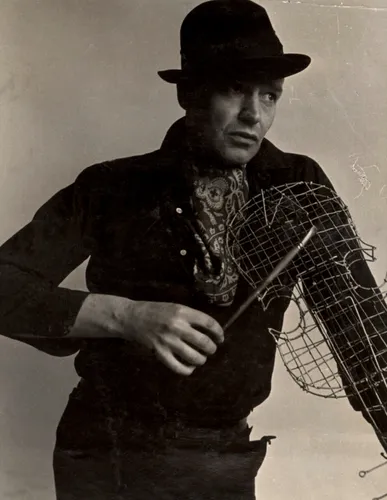
John Banting (1902-1972) was a Surrealist painter with an idiosyncratic style and a subversive sense of humour. He originally trained as a bank clerk while attending Bernard Meninsky's evening classes at Westminster School of Art. Banting then moved to Paris to study in 1922, where he exhibited with the Surindépendants, and met some important members of the avant-garde during this time, including Man Ray, Constantin Brancusi, and Peggy Guggenheim. He joined the London Group in 1927 and was invited to exhibit with the 7 & 5 Society in 1929.
In 1929, Banting was also involved in a famous and playful art world hoax, the so-called Bruno Hat affair. Together with his friend, Brian Howard, they invented an imaginary avant-garde artist called Bruno Hat and held a spoof exhibition at the house of the socialite, Bryan Guinness. A catalogue was produced, with an introduction written by Evelyn Waugh entitled 'Approach to Hat'. The artist himself even appeared at the private view (impersonated by Guinness' brother-in-law, Tom Mitford), brought in by wheelchair, muffled by scarves, and mumbling words in a broad German accent. But before too long the truth emerged. The event was in fact a complete hoax, and the pictures - painted on cork bathmats and framed in rope - were completed by Banting.
Banting's work was included in the 1936 International Exhibition of Surrealism in London, Fantastic Art, Dada, Surrealism at the MoMA, New York (1936), and the Exposition Internationale du Surréalisme in Paris, 1938 (at the invitation of Marcel Duchamp, whose partner, Mary Reynolds, became a lifelong friend). Artworks by the artist are held in collections including the Tate Gallery, the National Portrait Gallery, the National Museum of Wales, the Fitzwilliam Museum, and the MoMA.